Maximilian Moser – Professor of Physiology at the Medical University of Graz, author, Director of the Human Research Institute – Weiz, Austria

Augarten Grammar School
16 April 2024
Gymnasium am Augarten in Vienna, April 2024
Friendship with Nature, a school project as part of the class’s art week
Participants
Pupils at the Gymnasium am Augarten
Christian MICHAEL (FwN)
Maximilian Moser (FwN)
Paul Lukas Wagner (Gymnasium am Augarten)
Stefan Wirnsberger (University of Applied Arts)
Pupils going through puberty aren’t usually exactly keen on meditative music and botanical explanations. So what a pleasant surprise it was during our project in Vienna with the class from the Gymnasium am Augarten! A group of enthusiastic young people – exactly the sort you’d hope for as a teacher.
Paul Lukas Wagner, the son of a good friend and a dedicated teacher at this school, had contacted me some time ago to ask whether we could organise a spontaneous project featuring the music of plants as part of the school’s Art Week, and perhaps even create visual artworks inspired by this music. Thanks to the support of the Software AG Foundation, we were actually able to carry out the project at short notice. Stefan Wirnsberger from the University of Applied Arts in Vienna documented the project with film footage and photographs, which were then graphically altered and formed the basis of an exhibition at Café Wallenstein, as well as being shown at the Climate Biennale on Karlsplatz in Vienna (Music of Trees). After all, a key aim of our projects is to foster a bond between young people and plants through music, and thereby also to foster an understanding of the importance of biodiversity.

Photo: Christian MICHAEL
As this was our team’s first public project, we’d practised a little the evening before and set up the equipment at the artists’ café ‘Das Wallenstein’. The plan was for the project to take place mainly outdoors in Augarten Park, but torrential rain was forecast… and pour it did! Fortunately, there was a break in the rain in the morning, and the tall maple by the roadside had a few fresh leaves on its lower trunk, so we were able to let a tree have its say (or rather, make its music) – but more on that later…
After a brief introduction, during which I spoke about the background to the music of plants and explained our measurement method, a somewhat dusty houseplant was brought out and entrusted to the pupils’ care. Even during the introduction, the young people’s interest and excitement were palpable: “Will plants actually make music?”
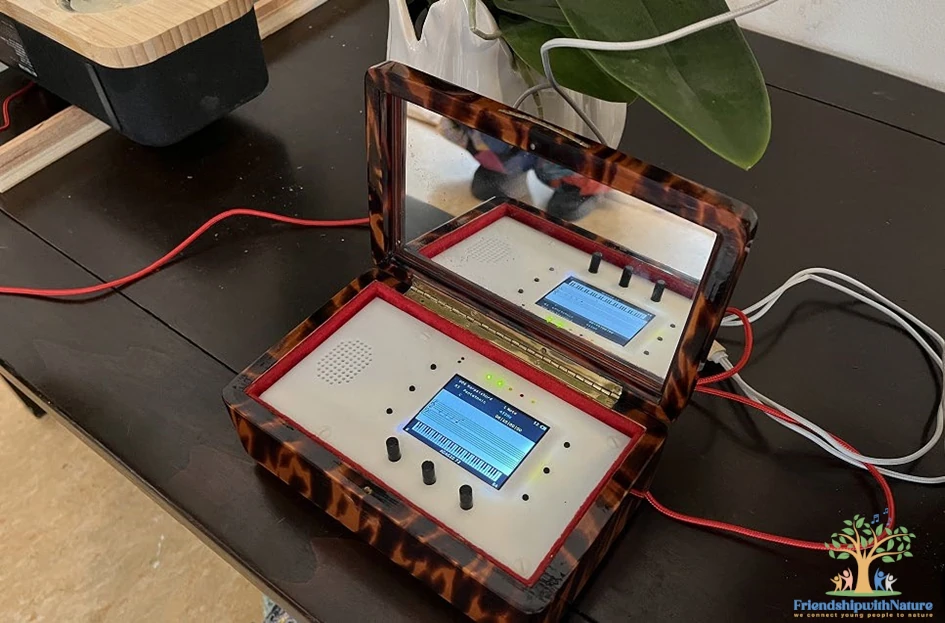
Photo: Stefan Wirnsberger
Treemuse
The Treemuse is our new device for bringing plant music to life. For the first time, it can display the notes a plant plays and, on a keyboard, the keys a piano would play if controlled via MIDI (a data standard used by musicians).
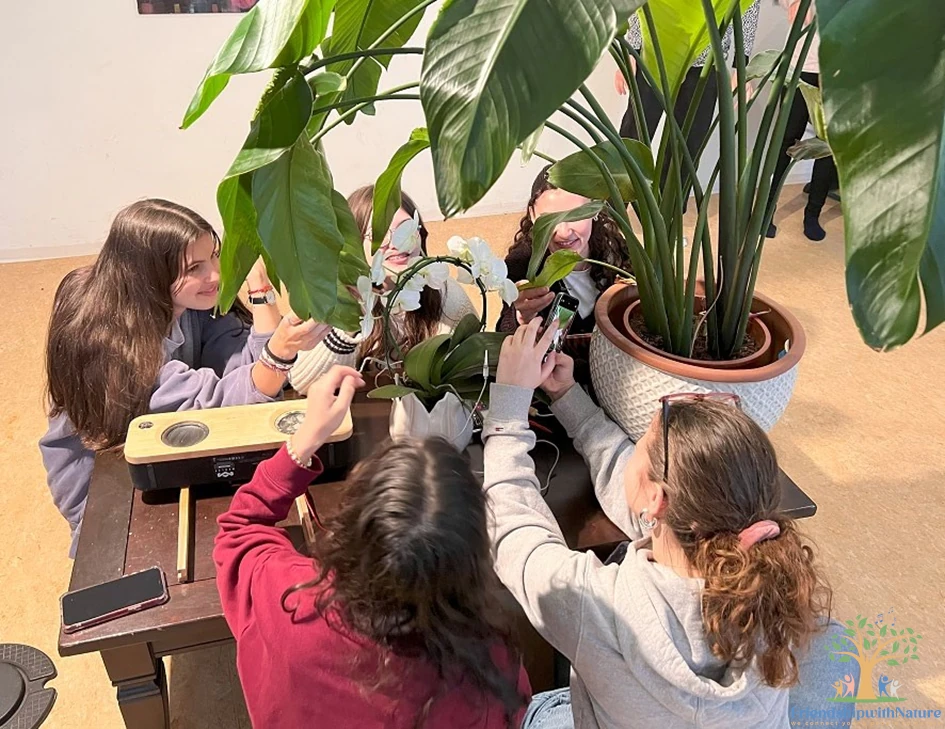
The pupils carefully cleaned the plant and then attached the electrodes – one in the soil of the flowerpot and one to a leaf. After a few seconds, the first piano notes rang out; the pupils were thrilled and later said that they had never imagined plants could produce such complex music,
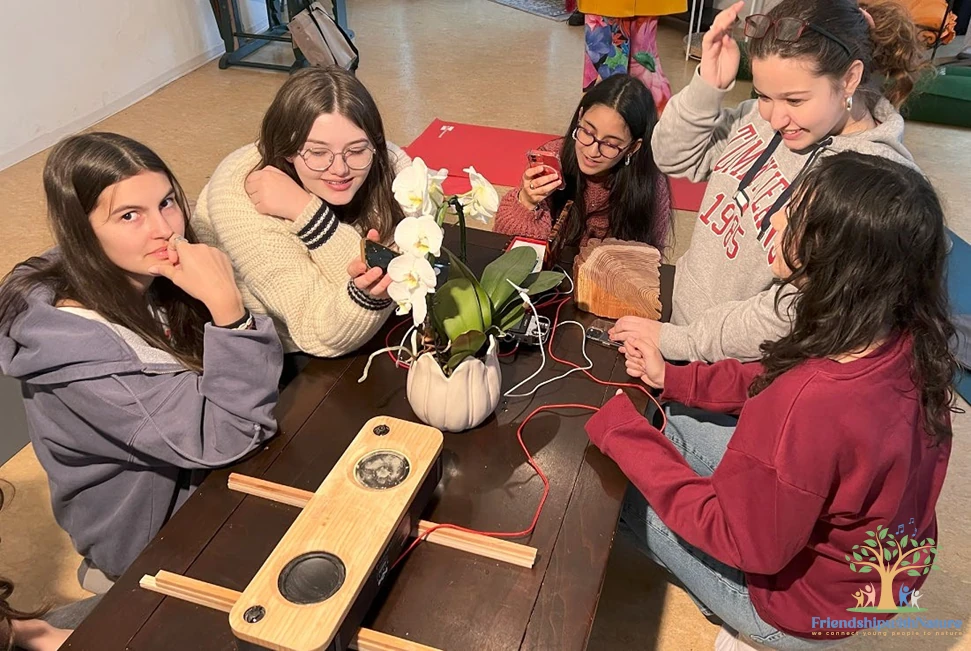
Kymatic Figures
For the first time in public, we demonstrated the visualisation of plant music using kymatic (kyma = Greek: the wave) figures. We filled one of the kymatic bowls with Lycopodium spores, which then arranged themselves into fractal structures in response to the music. The other dish was filled with water.
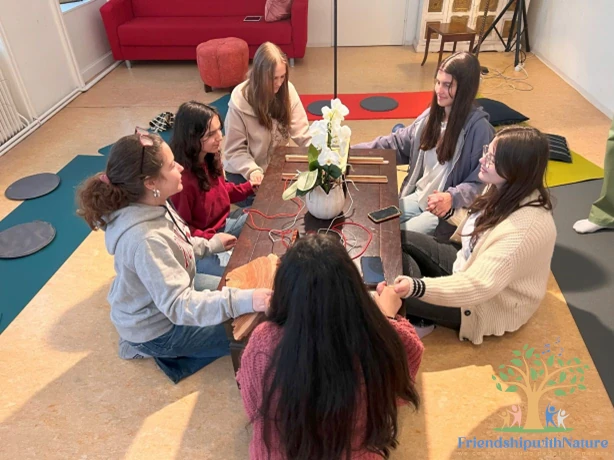
The pupils formed a circle, holding hands and including the plant and the TreeMuse within the circle; here too, the device did not let us down and played music based on the biological rhythms of the entire group.
Can trees make music?
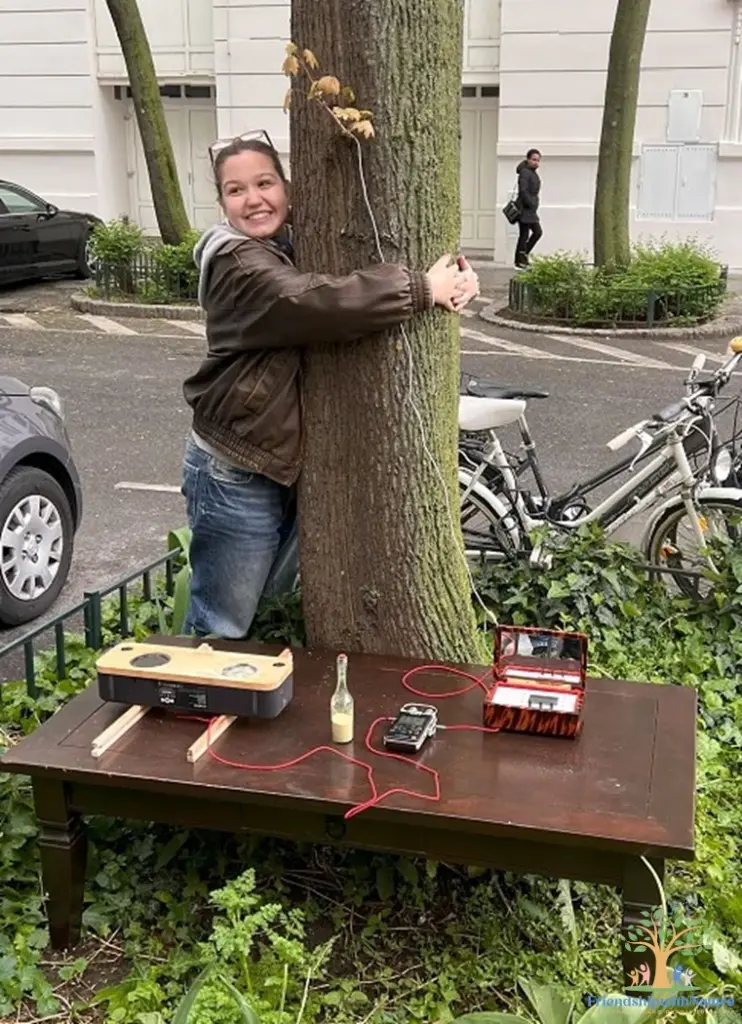
As we also – and above all – wanted to get trees to make music, we took advantage of a break in the rain to make a maple tree in the avenue in front of the Kunstcafe sing. The pupils watched with interest and carried out various experiments with the tree’s music: A particularly heartfelt embrace of the tree was documented both photographically and musically:
Do plants react to music?
I told them about a musician (Dagmar Trichtinger-Scharf) who had been practising a flute concerto by Vivaldi for weeks, playing the same piece over and over again. One day, she connected her houseplant – which had been listening to it repeatedly – to a
plant music device, and she said: “The plant played a theme that sounded just like Vivaldi!” We’ve also posted this sound clip on our website so that you can hear for yourself whether the plant’s music sounds like Vivaldi.
The pupils immediately proved to be very keen to experiment: they first played Mozart to the plant and then some hip-hop music from a mobile phone, listening intently for a possible response. Then all sorts of musical instruments were set up on the TreeMuse to produce the most striking sound patterns possible through the loudspeaker.
In a parallel project run by the music classes at the Gymnasium am Augarten, the plan is to combine the trees’ music we’ve recorded with additional human voices and instruments to create a song, which will then also be available online. A wonderful interdisciplinary and cross-class project on inter-species communication.
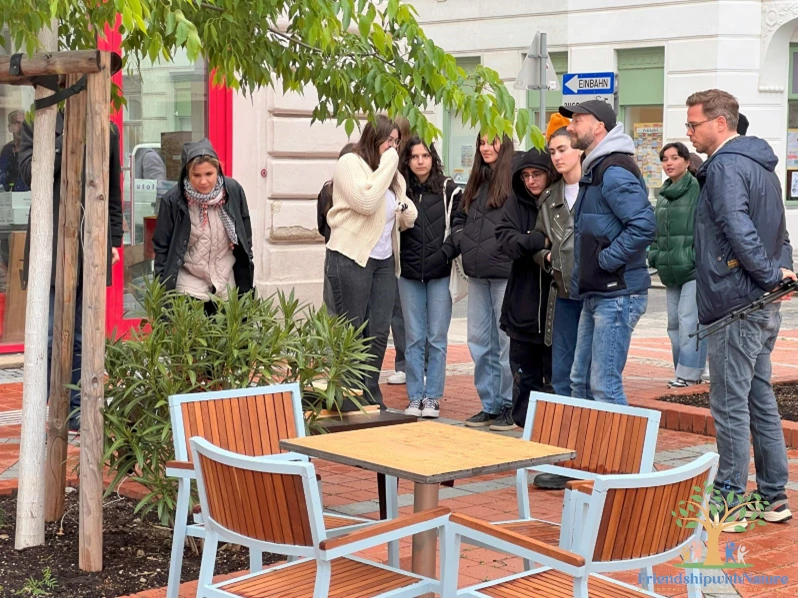
This Zürgelbaum on Wallensteinplatz in Vienna also produced captivating tree music and cymatic sound patterns, much to the delight of pupils and passers-by.
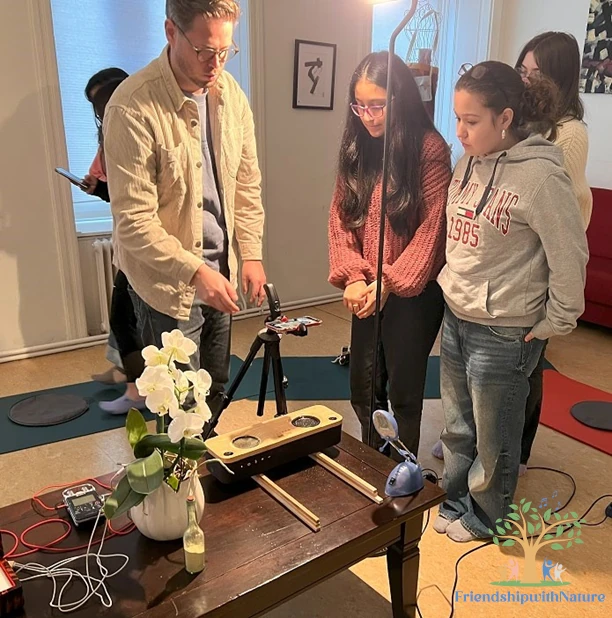
Precise photographs of the cymatic patterns produced by the plants’ music were then taken using a tripod; these were subsequently transformed into works of art during art classes and became part of an exhibition (“Sound Images as Inspiration for Innovative Urban Design”). They were also exhibited at the Climate Biennale in Vienna on Karlsplatz.
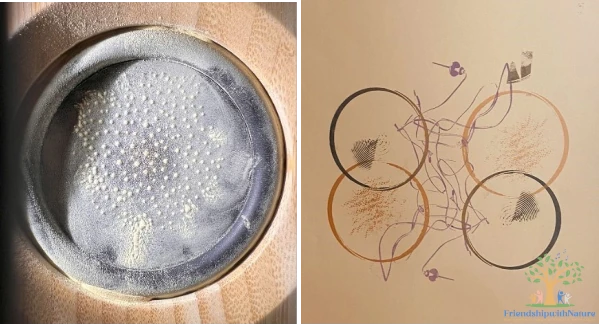
Original cymatic image (left) and graphic interpretation (right)
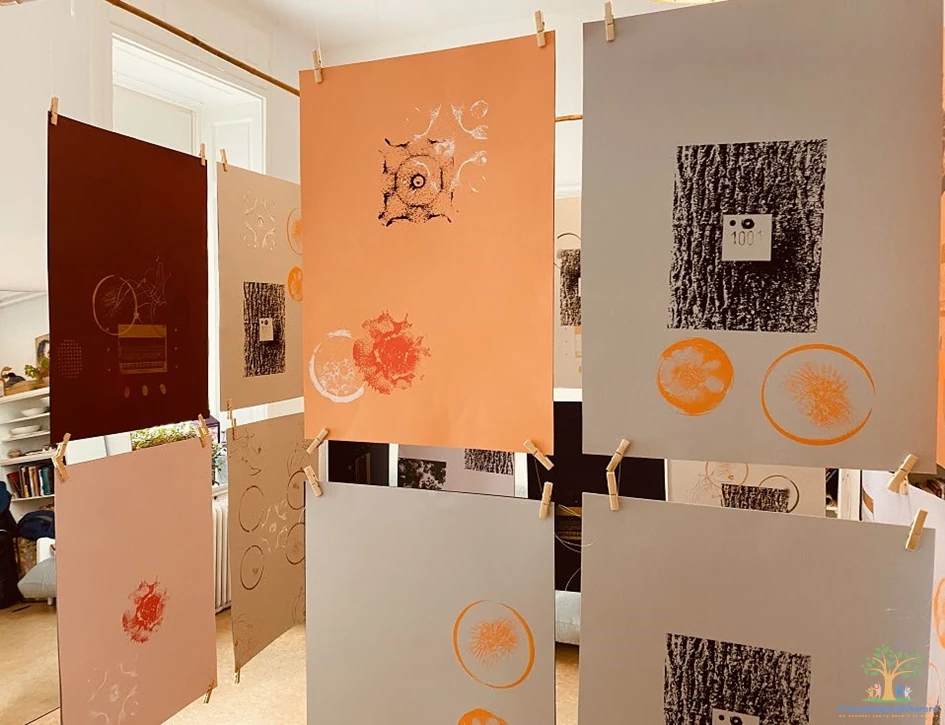
Exhibition of the images at the Kunstcafe Wallenstein
By the afternoon, the pupils were already very tired, and some fell asleep on the Wallenstein’s sofa, whilst others played various types of music from their mobile phones to the plant musician and observed her reaction.
As they seemed a bit down to me, I joined the tired girls and told them that, should things ever go badly, they should always remember: ‘The sun always shines above the clouds!’. At first, the girls showed no reaction – probably too tired…
At the end of the event, one of the girls came up to me and asked, “Did you really say that to us two hours ago, or did I just dream it?” I replied, “Yes, that thought has sometimes helped me a great deal in life when things were going badly for me.” The girl replied: “Because I actually did dream about the sun afterwards!” What a lovely gift, I thought to myself – for me, the loveliest part of what had already been such a rich day!
We would like to thank our sponsors: