Karl Schubert School, Graz, 20 June 2024
Friendship with Nature, school project
Participants:
Barbara Nickl (Karl Schubert School, Graz)
, Michaela Sulzer (Karl Schubert School, Graz)
, Nikolaus Popovic (photo documentary)
, Maximilian Moser (FwN)
It was a really hot June day and all the windows were wide open. Nikolaus Popovic, a trainee doctor from Graz and a friend of our institute, had kindly agreed to accompany us on the trip and provide photographic documentation.
After we began at 9 am, all the pupils first introduced themselves briefly and explained what particularly interested them about the project. They were pupils from the inclusive Year 6 class at the Waldorf School, aged between 11 and 13 – very interested, alert and lively children.
Now it was the turn of the tree slice from a 60-year-old larch to tell its story, which was met with lots of questions:
“What do the wood-boring beetles eat on the tree?” — mainly the sugar-rich bast layer.
“Do carnivorous plants have rhythms too?” — Yes, they do.
“What can you do with tree resin?” — I then explained how to make your own tree resin ointment for skin injuries: collect tree resin, melt olive oil and beeswax together with the resin in a bain-marie, pour into sections of bamboo, and the ointment is ready.
And many more questions!
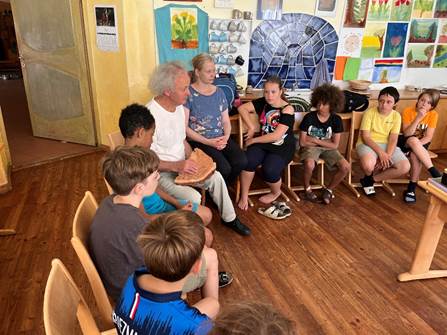
Picture: A tree ring tells the story of the tree’s life
Many of the questions I asked were answered enthusiastically by the pupils.
For instance, half the class raised their hands when asked who played a musical instrument; some even play several instruments.
The pupils then shared their own experiences with plants, giving very vivid accounts.
After an hour of storytelling and questions about annual rings and the tree’s life story, light and shade, water and drought, tree resins, cellulose and lignin, I noticed that their attention and alertness were waning – no doubt partly due to the heat – so we took a drink break.
Afterwards, with their full attention restored, the houseplants were dusted and lovingly cleaned. I then asked the class to sing another song for the plants, which they did without hesitation and with enthusiasm, after considering several suggestions.
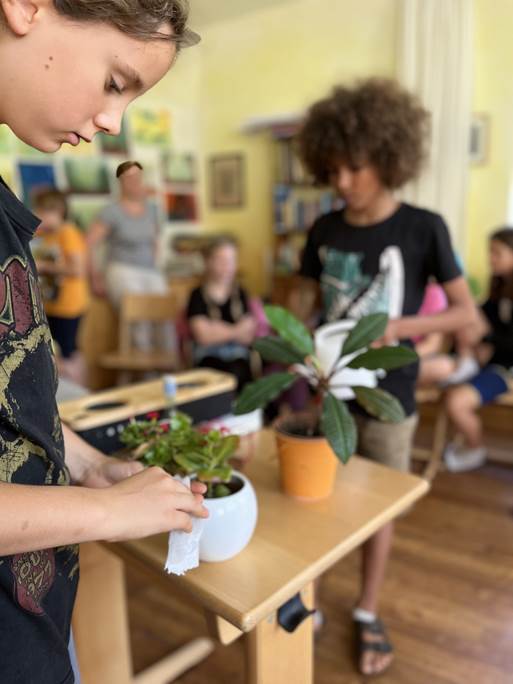
The plants are being carefully cleaned by the pupils.
And finally, the long-awaited moment that everyone had been waiting for arrived: the plants were connected to the new TreeMuse, and the class waited in reverent silence for the first note, which indeed rang out after a few seconds’ wait, followed by a constant stream of new melodies.
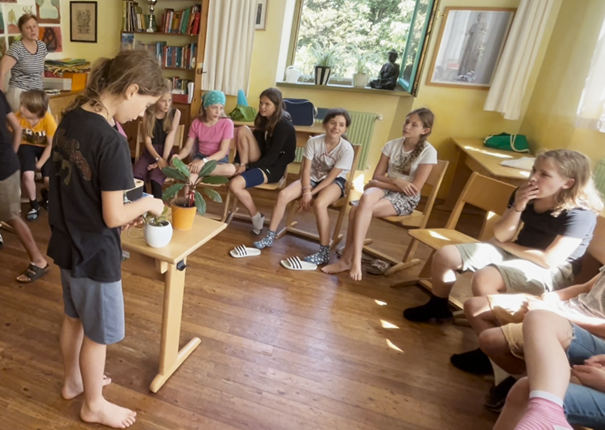
Picture: The plant music begins!
To let the trees ‘have their say’ too, we first made our way to a plum tree in the school garden, and finally the class spread out and ventured into the nearby woodland.
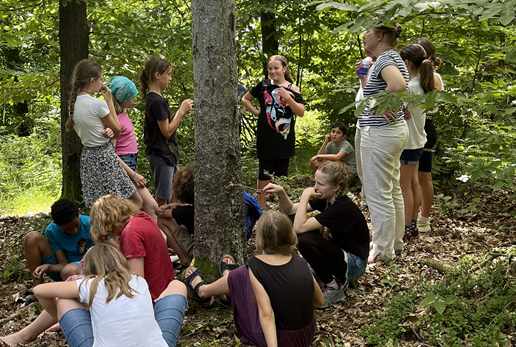
Picture: The children listen to the birdsong
We were surrounded by various deciduous trees, ferns and spruce trees. To get them in the right frame of mind for the woodland, I first asked them to listen to the diverse birdsong, which they did with great concentration. Then I asked how many different birds they had heard, and the answers varied widely. One pupil said one bird, others said two or three. A bright pupil of African descent had counted ten species of bird! On the way back, the teacher told me that this pupil was a huge animal lover and had discovered a dead female salamander in the spring, from whose body a young one was still emerging. He then raised the young salamander. A touching story from a lovely nature school!
The pupils chose a small beech tree and let it ‘make music’, then they headed back to the classroom.
Looking back, the pupils said that the music of the plants had been a wonderful experience for them, one they hadn’t expected to be quite so beautiful. They reported that the plants had responded to their attention and that they hadn’t expected plants to be so ‘talkative’. Their relationship with the plants and with nature has certainly improved significantly!
And so an eventful day came to an end, and the children are sure to remember this school day for the rest of their lives!
Contact details
office@friendshipwithnature.com
Website:
www.friendshipwithnature.com
Donations for school projects and research:
Salzburger Sparkasse, Friendship with Nature e.V., 8160 Weiz
IBAN: AT212040400043429489
We would like to thank our sponsors:


Gea – Methods and Techniques for a Healthy Environment gGmbH
Health and Nature Conservation in the Southern Odenwald e.V.